refrigeration · troubleshooting · updated 2026-05-28
Refrigerator Not Cooling: How to Find the Cause
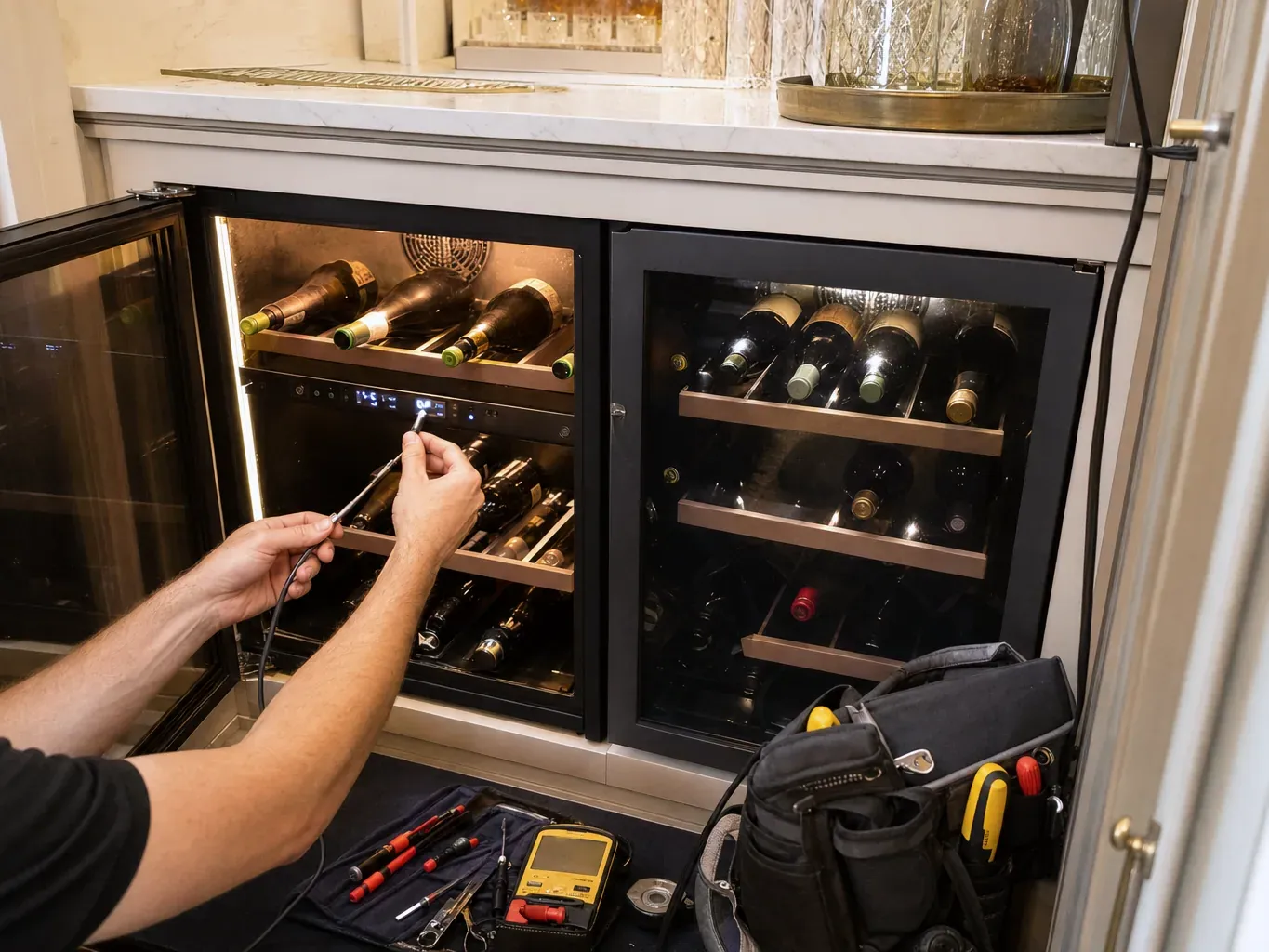
This covers freestanding refrigerators, the kind that stands between two cabinets or out on its own in a garage. Built-in column refrigeration behaves differently and is diagnosed differently. Around San Diego a very large share of the units that stop cooling are second refrigerators in garages, or older machines squeezed into a small kitchen with barely any air around them, and both of those situations cause faults that never appear in a manual.
Work out which half is warm before touching anything
Open both doors and feel. A freezer holding hard ice while the fresh food side sits lukewarm is a different fault from a machine where everything has drifted up together, and treating them the same wastes a day.
Freezer cold, fridge warm: cold air is being made and is not arriving. Look at the evaporator fan, the vents between the compartments and frost build-up on the evaporator.
Both sides warm: cold air is not being made. Look at the condenser, the condenser fan, the compressor start components and, last, the sealed system.
Put a glass of water in each compartment with a cheap thermometer in it and read them a few hours apart. Air temperature at the door swings wildly every time someone opens it; water does not, so it tells you whether the machine is losing ground or holding. Fresh food should settle near 37F and the freezer near 0F.
A garage refrigerator is often working outside its rating
Every domestic refrigerator has an ambient range on its data plate, and most are rated for a room, not a garage. Inland from the coast, in Poway, Rancho Bernardo, Scripps Ranch and the eastern communities, an unconditioned garage in late summer goes well past the top of that range for hours at a stretch. The compressor then runs almost continuously and still loses the freezer.
Two things make it worse. Garage units are usually the old refrigerator demoted from the kitchen, so the compressor is already tired. And single-sensor models read the fresh food compartment only, so on a hot afternoon the control keeps calling for cooling it cannot deliver.
If a garage unit holds temperature all winter and fails every summer, that is the answer and there is no broken part to find. What helps: get it off the sunny wall, clear a hand's width behind it, clean the condenser properly, and keep it reasonably full so the mass rides through the peak. A model sold as garage-ready has a different control strategy, which is the real difference between them.
The condenser coil, the fan beneath it, and coastal salt
The condenser is where the heat leaves. On most current machines it is a coil low at the back with a small fan pushing air across it, hidden behind a cardboard or thin steel panel. On older ones it is an open black grid across the whole back.
Blanket that coil and the machine cannot dump heat, so it runs and runs and slowly loses the freezer. Dust and pet hair do it everywhere. Close to the water, in Ocean Beach, Coronado, Point Loma and the Mission Beach lots, the film that builds on the fins is salt and grit together, and it sets much harder than household dust.
- Unplug it first. The condenser fan starts without warning.
- Pull the machine out and take the rear panel off, or reach the front grille if it has one.
- Vacuum with a brush head, then work a long coil brush through the fins.
- Check the fan blade turns freely by hand and that nothing has fallen into it.
- On a salted coil, a soft brush and patience work; a hose does not, and bending the fins makes it worse permanently.
Do this once a year inland and twice a year within a few blocks of the ocean.
Small kitchens: the alcove the machine has to breathe in
A refrigerator fitted into a cabinet run needs somewhere to send the hot air it produces. In a lot of older San Diego housing, and in most condo kitchens, the alcove was sized for a narrower machine from decades ago and the current one has been wedged in.
Check for the usual three: a cabinet built down over the top with no gap, the back pressed flat against the wall, and a side touching the run. Manufacturers generally want a small clearance at the back and top, and that gap is not decorative.
The tell is a machine that cools acceptably in the morning and gives up by evening, with the cabinet above it noticeably warm to the hand. In a rental, that hot cabinet is worth photographing before anyone starts changing parts.
Frost sheeting the freezer back wall points at defrost
Behind the freezer's rear panel sits the evaporator, and a small heater is supposed to melt the frost off it several times a day. When that defrost circuit stops working the frost keeps building until it blocks the airflow completely.
The pattern is distinctive. It cools normally, then over a week or two the fresh food side gets steadily warmer while the freezer stays cold, and you may hear a fan ticking or scraping as the blade catches ice.
To confirm it, empty the machine, leave both doors open and the power off for a full 24 hours, then run it again. If it cools properly for a couple of days and then repeats the same slide, the defrost heater, the defrost thermostat or the control that times them has failed. A manual defrost is a diagnosis, not a repair; it will come back.
The evaporator fan and the path the cold air travels
On a machine with one evaporator, a single fan pushes cold air into the freezer and through a duct into the fresh food compartment, where a damper meters it. Anything in that path stops the fresh food side cooling while the freezer carries on.
Open the freezer and listen. Most models cut the fan when the door opens, so hold the door switch in with a finger or a piece of tape and see whether the fan starts.
- No fan and no ice on the evaporator: usually the fan motor or its supply.
- No fan and the blade locked in ice: the defrost fault above, not the fan.
- Fan running normally: check the vents inside. A bag of bread or a stack of containers pressed against the fresh food vent will do the whole job of a broken part.
Packing a refrigerator solid, which happens in small kitchens with nowhere else to put anything, causes this constantly.
Door seals fail slowly and take the temperature with them
A gasket does not usually tear. It goes hard, loses its magnetic grip, or the door drops a few millimetres on a worn hinge cam and stops meeting the cabinet squarely at the top corner.
Test it with a strip of paper. Shut the door on the paper and pull. It should drag. Work around all four sides, and pay attention to the top corner on the handle side, which is where a dropped door lets go first.
In rentals and in houses with children the other cause is simple mechanical abuse: door bins loaded until the door will not swing shut on its own, or a door held open while someone decides. Neither is a fault, and both raise the running temperature enough to notice.
A gasket that has gone hard can sometimes be improved by warming it, but a seal that no longer holds paper anywhere along a side is done.
Refrigerant is not a top-up item, and what to do meanwhile
Domestic refrigerators are sealed at the factory and are not designed to be recharged. There is no service port, the charge is small and weighed to the gram, and a system that is low is low because it leaked. Anyone offering to simply add gas to a household refrigerator is describing something that does not fix the reason it went.
A genuine sealed-system fault, or a failed compressor, is the point where the age of the machine starts to matter more than the fault does.
While you are working through the checks: move what matters into an ice chest rather than opening the doors to see whether it is any better. Do not switch it off and on repeatedly, because a compressor restarted against pressure trips its own overload and gets hotter each time. A compressor that gets hot and clicks every few minutes is stalling on start, which is commonly the start relay or the overload rather than the compressor itself, and neither is a part to guess at.
What you can check yourself
- Read both compartments with a thermometer in a glass of water, not by hand at the door.
- Check whether the compressor and the condenser fan are running at all.
- Unplug and clean the condenser coil and fan properly, twice a year near the coast.
- Confirm the machine has clearance at the back and top and is not boxed in tight.
- Hold the freezer door switch in and check the evaporator fan runs.
- Look for frost sheeting the freezer back wall, which points at the defrost circuit.
- Test all four sides of both door seals with a strip of paper.
- For a garage unit, compare how it behaves on a hot afternoon against a cool morning.
More guides